

Enough is Enough
“Muddy water is best cleared by leaving it alone.” ― Alan Watts

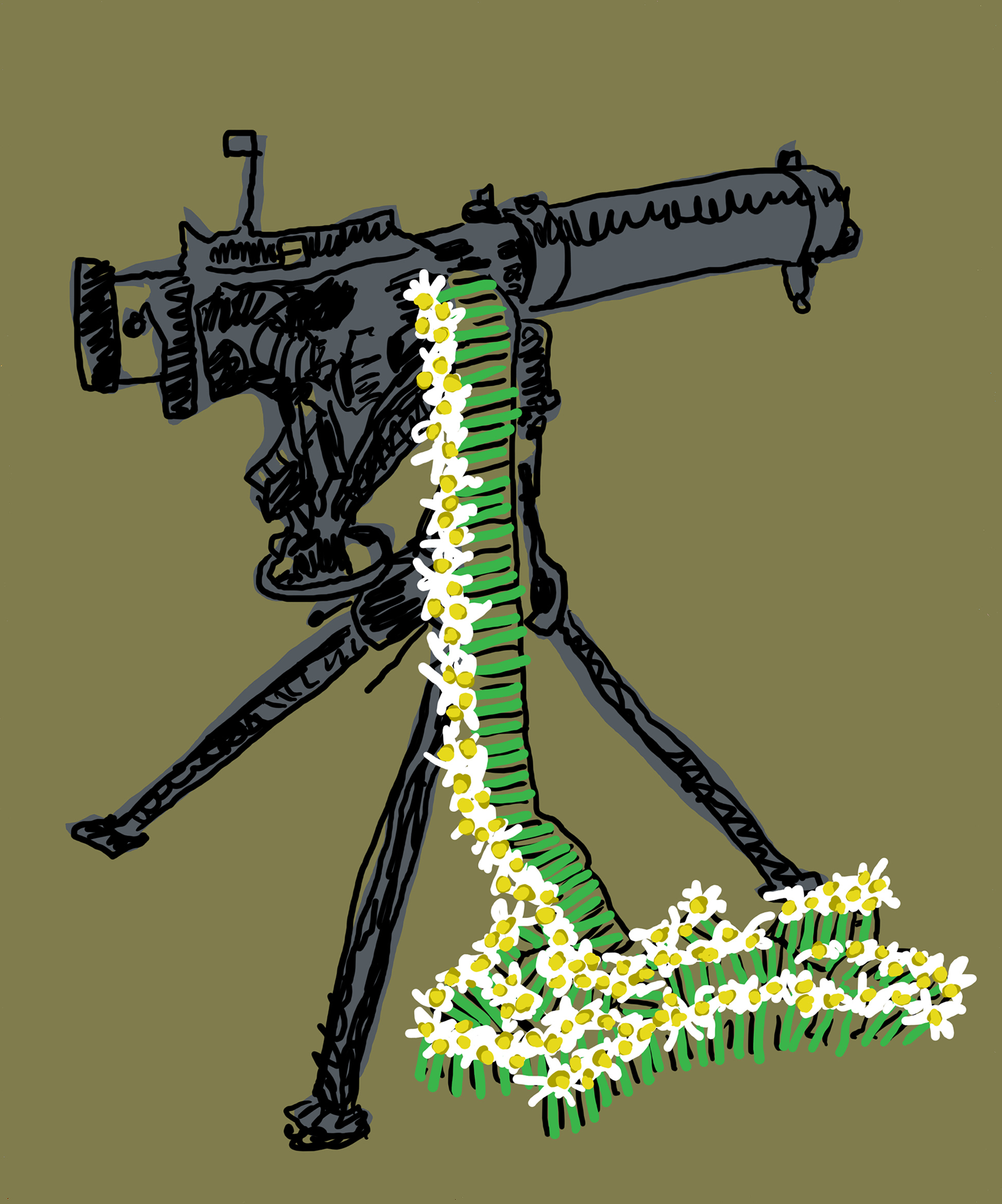
I gave a talk at Drury University in Missouri a few years ago about the importance of confronting challenging material in art and politics with direct engagement and sober deliberation rather than with the bumptious hysteria typified by so much public opinion these days—hysteria usually led by of a bunch of Gestapoed Blanche Duboises who have been deputized by the lords and ladies of good taste to perpetuate the con that overcast days are somehow deplorable when compared to days that are otherwise cloudless and dominated by a raging sun, the latter never allowing a face-to-face interrogation of God and always insisting on a subservient bow of averted eyes. During the Q&A I had a truncated debate with an attendee who insisted that offensiveness was not always a bias and, in circumstances where morality was impugned, should be recognized as a dangerous assault on human decency. I agreed that while aged Cotija cheese might smell strongly of vomit and that the stench of vomit is definitely offensive to practically everybody, I would never think I had an obligation to start a censorship campaign that insisted we all ignore Mexican cuisine and remain incurious about how grating Cotija over a hearty broth or side of refried beans might in fact make life more enjoyable to a great number of us, knowing that by attributing malice to the aroma of puke would be the same thing as attributing munificence to sunlight and glee to the inadvertent grin of an upturned banana.
Indeed, if I were part of a growing international movement that insisted, by way of an actual example, on the vilification and censorship of Trey Parker, Matt Stone, and Robert Lopez, the writers and composers of the hugely successful musical comedy The Book of Mormon, I believe the singular requirement that supporters of the play would be entitled to demand of me is that I first see the production. Similarly with the work that I and others do as artists, writers, journalists, and poets, the singular requirement we must demand of our detractors is that they actually view our compositions and consider them in context with the specific points being argued regarding the political, cultural, or religious particulars to which our commentary is responding. Verily, practically every censorship campaign ever waged against a book or piece of art has been one leveled against hearsay about the work and practically never about the content materiality of its intent.
When, for example, attempts were made in the 1940s by church groups, vigilante parent organizations, and self-appointed social crusaders to ban the sale of comic books to minors because there were unsubstantiated rumors that insisted consumption of such material would lead to defiant behavior, delinquency, rape, murder, and, ultimately, Godless communism, none of the complainants would ever debase themselves by saying they actually read a comic book nor would they ever come close to saying they understood why the genre might appeal to a demographic exhilarated by escapist literature. Likewise with The Book of Mormon, those making the loudest noise about the need to cancel the play were the ones proudest to admit that they hadn’t seen it. In fact, always missing from the charges of gross indecency by denigrators of the show was any discussion about the whole point of the comedy’s narrative: without permitting a combination of grace, respect, empathy, and critical thinking into our communal conversations about the apparent virtues and potential dangers of religious orthodoxy, we run the risk of allowing our ability to negotiate compromises between our differences of opinion to be crushed by our capitulation to dogma. In other words, it would be a disservice to both the public and the performers—and the functionality of a democracy, itself!—to permit those passing by the theater, who might pause to press their ear against the stage door and to hear the refrain from one of the show-stopping numbers, “Hasa Diga Eebowai,” where the singers exclaim “Fuck you, God!” to be the ones allowed to frame the parameters of the debate about the viability of the musical and to be given the leverage to egregiously misrepresent it by ignoring the full unexpurgated narrative. Surely, we cannot allow the least qualified among us to control the narrative about what is and what isn’t useful information; information, that is, upon which to base our understanding of each other and the culture and the politics we concoct to give our interactions productive structure.
Now, as the United States continues its perilous disintegration like a dainty old biscuit beneath the serrated and unrelenting piss streams of MAGA Republicanism and self-aggrandizing liberal elitism, it is becoming increasingly obvious that this is exactly where we’ve landed as a country and I can’t help but lament the loss of an arts and academic community that at one time seemed both capable and eager to course correct a society made ever-increasingly dull and ideologically pliable by its cowardly allegiance to the dehumanizing dictates of the status quo. Where in modern-day America, for example, would we expect to find somebody like James Baldwin or Alan Watts or Bertrand Russell or Mario Savio or Jack Kerouac or Susan Sontag or I.F. Stone or Mother Jones to frustrate the never-ending attempts by Big Brother™ to rewire our entire population to be less reliant on its own innate impulses towards cooperation and fairness? What is it about not giving a shit that excites most Americans these days way more than giving a shit seems to, acclaimed 20th century agitators like George Carlin, Norman Mailer, Angela Davis, Sylvia Rivera, Malcolm X, Bob Dylan, and Noam Chomsky having been replaced by the obliging emissaries of corporate groupthink like Taylor Swift, Kim Kardashian, Charli D’Amelio, Bryce Hall, Andy Cohen, Ryan Seacrest, and Oprah Winfrey?
It appears that as the democracy dies, imperceptibly to most like the slow-motion emergence of greasy bruises on a bag of moldering olives, so too does the history of resistance and all that once inspired our enthusiasm to identify potential threats to the longevity of a republic built on the sublimely fragile theory of I am she as you are he as you are me and we are all together. Has our sense of togetherness, itself, become the very threat we seek safety from, with our congregation around our mutual submission to power feeling as close to a rah-rah unanimity as we can muster? Is our collective surrender to defeat and compliance with doomsday something we’re doing or something that is happening to us? All things die, that’s true, the act of falling apart being as essential to the cohesive patterning of the universe as coming together, a something literally defined by the nothingness it is buttressed up against with neither sustainable as a solitary phenomenon. So, what then does our potential extinction tell us about the meaning of life either as a collective experience or something encountered individually? Are we really losing something precious and miraculous upon perishing or is our perishing the very thing exemplifying, even emphasizing, the wondrousness of our ever having been here in the first place? Is it fair to assume, or even accurate to surmise, that what appears to be our unwillingness to save ourselves from disappearing is a deterrable act of mass suicide? What if instead of being an unwillingness to save ourselves it’s an inability, the sort demonstrated by the lifecycles of all finite things, whether we’re talking about daylight, dung beetles, beards, laughter, stars, quarks, wars, or peaces, none of them are ever eternal and all must end having sprung just as inevitably from a correlative beginning initiated by a state of pre-existence. Gosh, physicists aren’t even able to say for sure that time, itself, isn’t just an irregular anomaly bound—or would it be unbound?—by its own impermanence.
If, in fact, our fate has been sealed because we are irrevocably linked to some impossibly complex system that we have zero ability to understand or knowingly affect, are we at least partially unburdened from needing to think of a way to save ourselves from self- annihilation? What if willing ourselves to stop disagreeing with each other, or to stop justifying so many wars, invasions, and occupations, or to stop creating more and more lethal technologies from which we are less and less likely to survive, was the same thing as expecting a chihuahua to be able to do long division simply by concentrating harder on the capacity to do so or that after repeated nights of weeping in front of a goldfish one might expect it to eventually leap from its bowl, sit you down, make you an omelet, and reassure you, while gesturing with a spatula, that, “That psycho-bitch, Kim, doesn’t deserve you! She’s blown so many guys behind your back that birth control for her is a stick of gum! You should have known something was up when she said the calluses on her uvula were from a lifetime of mispronouncing guacamole—just forget about her!”
If that is the case and we are destined to expire simply because of where the biorhythm of the species happens to be and there is nothing we can do to postpone it, there is still no reason to stop attempting to live a life as full of grace and kindness as possible, and also to call out injustices wherever we see them and to assuage the suffering of those being tormented wrongfully by oppressive bullies. True, there definitely appears to be fewer and fewer agents of positive change occupying inspiring positions of defiance in the arts, politics, and public intellectualism these days, but so what? When we mourn the absence of leaders in these fields we are doing so from the viewpoint of a follower seeking both the guidance offered by some version of supremacy, whether it’s based on talent, charisma, or sheer brilliance, and the company of other followers yearning for the camaraderie that comes with solidarity. Are we then not in greater danger of settling into a subordinate position, more a consumer of pro-people shitgivery than a manufacturer, where we allow the subject or subjects of our affections to embezzle the charity of our support as kindling to be thrown in with the kindling of other supporters, all in service of creating a firestorm capable of fostering new growth in a forest that we’ve decided is in desperate need of reincarnation? Is this not the same position too often taken by those we most abhor, whose own version of reality has cast us as the hazardous buildup of dry vegetation needing to be burned away? Way too often the fight between those arguing the merits of conflicting ideologies is waged among peons employed by the same company, sometimes even standing side by side on the same assembly line, whose paychecks are coming from the same pool of blood money siphoned from the same reservoirs stored at the bottom of the same hierarchical pyramid where we live and work—a pyramid built a long time ago to last forever by leaders with whom our forefathers felt we could all trust to protect us from the sort of harsh and unforgiving elements that only a lack of windows can confirm.
Yes, Shakespeare gave us a language with which to use when translating our experiences into poetry, but what of the more consequential poetry upon which the language is fitted like costumes draped over the ineffable nudity of the wordless experiences we crave and savor and learn from outside the theater? Is there no doomed love capable of reconciling the differences between rival houses without the Bard of Avon? Are there no insights into the potential combustibility guaranteed by a noxious combination of love, power, and revenge without the invention of the pen and quill? Is there no elation in a silence unpopulated by a Bach fugue? Does the patter of rain or the rustling of leaves or the crashing of ocean waves ever need translation—when translated, how often does the translation upstage the thing that it’s paraphrasing? Similarly, is there no equality among a group of people without the written permission for there to be such a thing from a governing body that must float somewhere above equanimity to have the power to distribute it? To assume it is a legislature that grants the members of a society the ability to speak freely and to communicate their opinions on any subject they can name is to assume that a law-making body is necessary for freedom of speech to prevail at all, which is to condone the bizarre supposition that glitterati must exist as a higher authority vested with the power to enable the autonomy of a population for without them the population would be forever lost in an unstructured cacophony of monomania.
Of course, none of this is true and the sooner we divest ourselves from the con that the integrity of our personal experiences must always rely on the encouragement or discouragement of people in positions of authority, revered or despised, the better off we’ll be. Of course, testing the soundness of one’s perspectives against the perspectives of others from every walk of life—others including not just people, but the light, shadow, breezing, buzzing, and barking of everything we encounter—and to either delight in the harmony of those perspectives when they align and resonate with one another or to feel the motivating sting when they don’t, is all part of the essential and inescapable choreography expected of all things made to coexist in a shared space at any given time. It would be inaccurate to consider these interactions as contests between opponents whose whole purpose for communicating with one another is to reveal the crisp parameters of a single truth through some sort of barter, with one conviction able to delegitimize the sentiment of another through argument, as if our limited language of either/or bifurcation had a superior ability to decipher what the real meaning of life is over the language of the universe, which is purely illustrative and, by simply showing and not telling, becomes perfectly incontrovertible.
Awaiting a visit from my opinionated daughter to whom everything is an insurmountable problem to be mercilessly grappled with before piling on more obstacles to argue are insurmountable, and I find myself floating off to a paralel universe, (in order to let the mud clear)
Your thesis amused me DEEPLY
Masterful prose!
I sometimes think that those who suffer the most in these times are those whose doors of perception have been cleansed. But they do not suffer for themselves; instead, they suffer for those whose doors of perception remain perennially smeared by self-righteousness, false dichotomies, either-or thinking, and frightened aversion to direct experience.
But you may have provided an answer for this dilemma: "that as the democracy dies ... there is still no reason to stop attempting to live a life as full of grace and kindness as possible, and also to call out injustices wherever we see them and to assuage the suffering of those being tormented wrongfully by oppressive bullies."
After all, what else is a poor bodhisattva to do?
These are difficult and troubling times. And I am increasingly convinced that Spengler was right. Civilizations have an organic lifecycle. Ours is now caught in a perfect maelstrom of conflicting interests and negative influences and is rapidly becoming terminal.
Remember Francis Fukuyama's dramatic claim that "What we may be witnessing is not just the end of the Cold War, or the passing of a particular period of postwar history, but the end of history as such: that is, the end point of mankind's ideological evolution and the universalization of Western liberal democracy as the final form of human government."? He too was right. We are at the end of history. But not in the way he thought. Having defeated their Godless Communism, we were left with our own Satanic Neo-Liberalism instead.
It wasn't supposed to happen. I grew up believing that those bad things only ever happen "over there", never here. It never occurred to me, or anyone else for that matter, to ask: why not here?