

Nasty Behavior
The business of art lies just in this—to make that understood and felt which, in the form of an argument, might be incomprehensible and inaccessible. —Leo Tolstoy

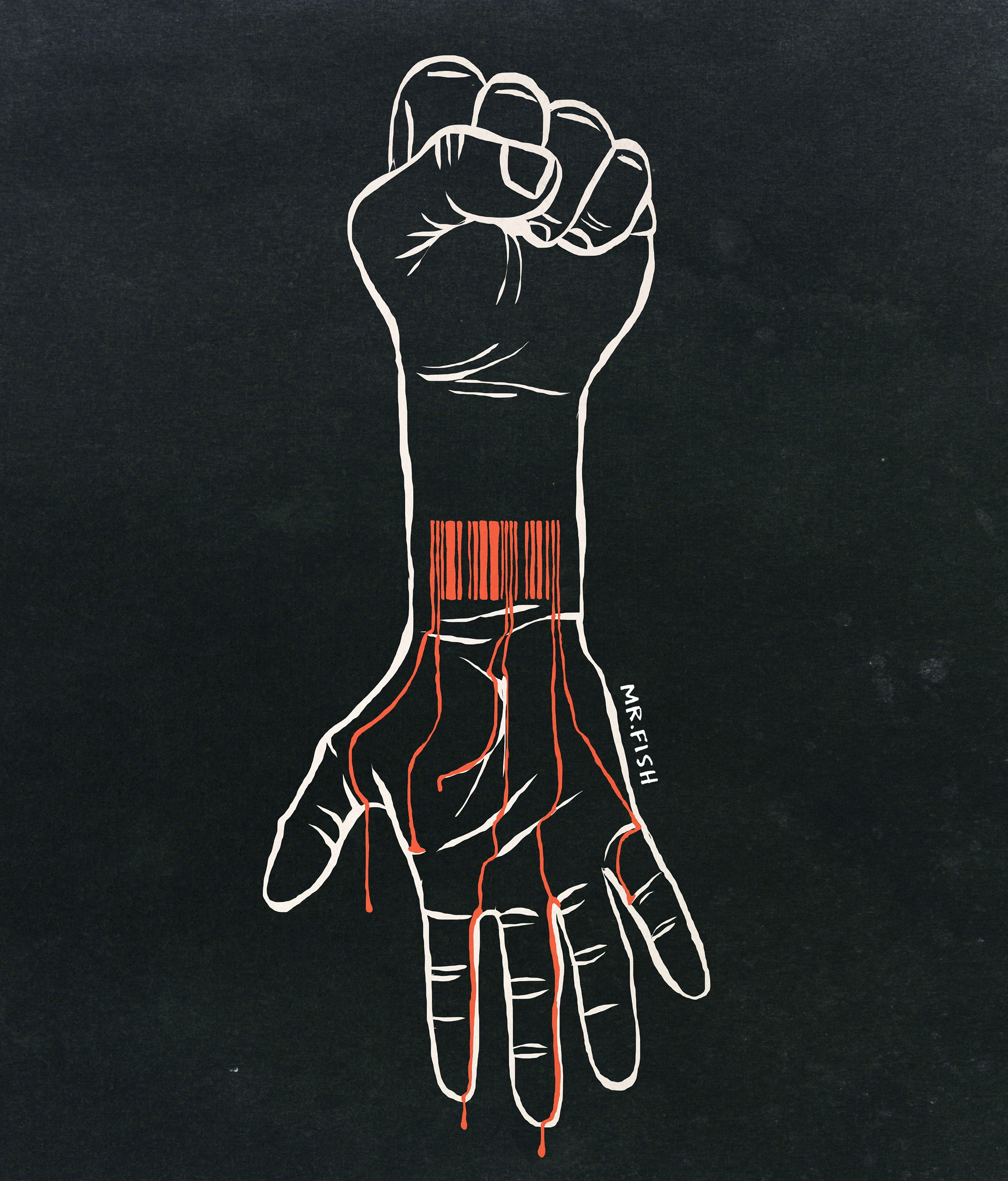
Often used as a folksy aphorism devised to celebrate the stupefying effect of diagrammatic aesthetics, the well-known adage “A picture is worth a thousand words” has frequently been attributed to Napoleon Bonaparte, who actually said, “A good sketch is better than a long speech.” Scholars speculate that, rather than expounding on the inexplicable wizardry of a pretty piece of art, he was either commenting on the field drawings provided to him by his officers depicting the terrain upon which the Emperor hoped to advance his troops, or he was talking about the usability of military charts and maps detailing the positions, strengths, and weaknesses of his enemies. Either way, Napoleon was acknowledging the rather obvious precept that visual literacy has always had a very definite advantage over language-based modes for both explanation and comprehension of the outside world, whether one was waging a war or keeping a peace or maintaining a status quo. It is an acknowledgement that suggests correctly that style and beauty have only marginal and circumstantial significance over the ability of an image to leave one simultaneously speechless and well informed.
After all, hardwired into the genetics of every human being not afflicted with blindness or mental illness is the innate ability to interpret, without bias, the visual cues that physical reality bombards each of us with every day, and it is precisely this absolute recognition of direct reality—a recognition that persisted for eons independent of the balderdash on offer from the verbal and conceptual cues that we currently use to qualify and quantify our experiential appreciation of being—that has sustained the species for upwards of 6 million years. In fact, it is arguable that it is precisely through the development of language and cogitation that we have forever crippled our natural ability to directly grapple with real life, with our tendency to alter our perception of objective fact into subjective opinion amounting to the deliberate creation of a worldview based entirely on theoretical supposition, sentimentalism, and sheer imagination. No longer capable of perceiving even another person without first reacting idiosyncratically to his or her class, political leanings, religious inclinations, and sexual viability, we have made ourselves gullible to innumerable prejudices, myopic, self-perpetuating fantasies, and the deranged misconception that theories of right and wrong, of beauty, meaning and normalcy, are somehow proven to be actual when made to correspond with a physical equivalent; i.e., a national flag, which is nothing more than colored fabric stitched together, will equate to a tangible moral virtue worth living and dying for an African American will equate to spooky, violent buffoonery a rectangle of printed currency will equate to justification for a lifetime made frivolous by wage slavery and wanton destruction of the ecosystem, for love, hate, and the most lethal form of self-censorship—particularly for those who might otherwise be inclined to openly criticize wage slavery, destruction of the ecosystem, misguided affection, aberrant hostility, and loss of income equating to loss of life.
Intrinsic to the integrity of human consciousness is the imperative that something of what a person believes corresponds directly with something in the real world, or corresponds directly with something depicted by a cartoonist mimicking isolated elements of the real world for the purpose of mocking or praising them in the service of some contrived notion of justice, malice, revenge, or revelry.
In 1871, having spent years being lampooned by Thomas Nast, the most celebrated American political cartoonist in the country, William Tweed, who was the ward boss of Tammany Hall, the notoriously corrupt political organization of New York’s Democratic Party in the later part of the 19th century, famously said, in response to criticism from the press, “I don’t care a straw for your newspaper articles; my constituents don’t know how to read, but they can’t help seeing them damned pictures!” It was a comment that, though shot from the hip and definitely meant to reinforce Tweed’s reputation as a magnetic personality supercharged with enough political and business dynamism to permit him the luxury of saying the most inflammatory things without fear of professional repercussion, was particularly meant to publicly shame Nast, with the implication being that propagandizing with pictures made verbal discourse impossible and that cartoons were deterrents to the smooth running of industry and civil servitude. It was as if Nast’s cartoons could only cheapen the Fourth Estate’s mission to inform, enlighten, entertain, and enrage by excluding the first three tenets of the mission and inciting the public to react to an exaggerated caricature without the comparative gentlemanship afforded straight mudslinging journalism.
Indeed, the power of the editorial cartoon in the case of “Boss” Tweed’s exposure as an unscrupulous politician proved enormously influential, if only because Nast’s work provided visual shorthand with which New Yorkers could decry the Tammany chief. The oversimplification and dehumanization of the Democrat leader was key to motivating swift action from those who prefer that their targets remain still, two-dimensional, composed of only ink and paper and unlikely to bleed or garner any sympathy while being eviscerated. It was the kind of artistic sorcery used by Honoré Daumier in his depiction of King Louis Philippe as a pear, by Arthur Szyk in his depiction of Emperor Hirohito as some unholy hodgepodge of Jerry Lewis, Fu Manchu, and Steve Urkel, by Mike Luckovich in his depiction of George W. Bush as a progressively smaller pipsqueak, donkey-eared, simian rube, by Paul Conrad in his depiction of Richard Nixon as a scowling, baggy-eyed, unshaven King Richard II, and by nearly every single editorial cartoonist working today in their depiction of Donald J. Trump as, well, Donald Trump, the literal personification of a living and breathing cartoon character that no amount of satirical exaggeration could legitimately amplify beyond what is actual.
So effective was the use of artwork in the denigration of public figures that there have been numerous attempts over history to pass legislation designed to prevent cartoonists from using hand-drawn images to express an opinion about how and why the world functions as it does. Focusing only on the short history of the United States—and ignoring the imprisonments, tortures, fines, and broad censorship laws meted out in other countries over the centuries—anti-cartoon bills were introduced in the New York legislature in 1897, in California in 1899, in Indiana in 1913, and Alabama in 1915, although the most nationally known attempt to censor newspaper artists was introduced into the Pennsylvania legislature in 1903. The bill, most likely written in response to the depiction of Samuel Whitaker Pennypacker, who was a conservative judge running for the governorship, as a parrot, proposed the banning of “any cartoon or caricature or picture portraying, describing, or representing any person, either by distortion, innuendo or otherwise, in the form or likeness of beast, bird, fish, insect, or other unhuman animal, thereby tending to expose such person to public hatred, contempt, or ridicule.” Fearing a snowballing disdain for the power of the press and the potential for the enaction of irreversible reforms abridging free speech, the bill was roundly scorned by innumerable newspapers and lambasted by the public and never passed.
Eventually, of course, the brunt and toxicity of cartoons and caricature previously crafted to erode the persistent authoritarianism of elite and venal power structures found sponsorship from their actual targets, instantaneously transforming reprehensible men and culpable organizations into sham champions of free speech—the idea being that a tobacco company that appears concerned enough with the public’s health and well-being to post cancer warnings will always sell more cigarettes.
Caricatures are a relief from dreary paragraphs.
For we visual learners, pictures paint more than just a thousand words--it's more like millions to us!
(Probably why I collect political/cultural memes. They "speak" to me.)