

The Gag Reflex
“Censorship is to art as lynching is to justice.” ―Henry Louis Gates Jr

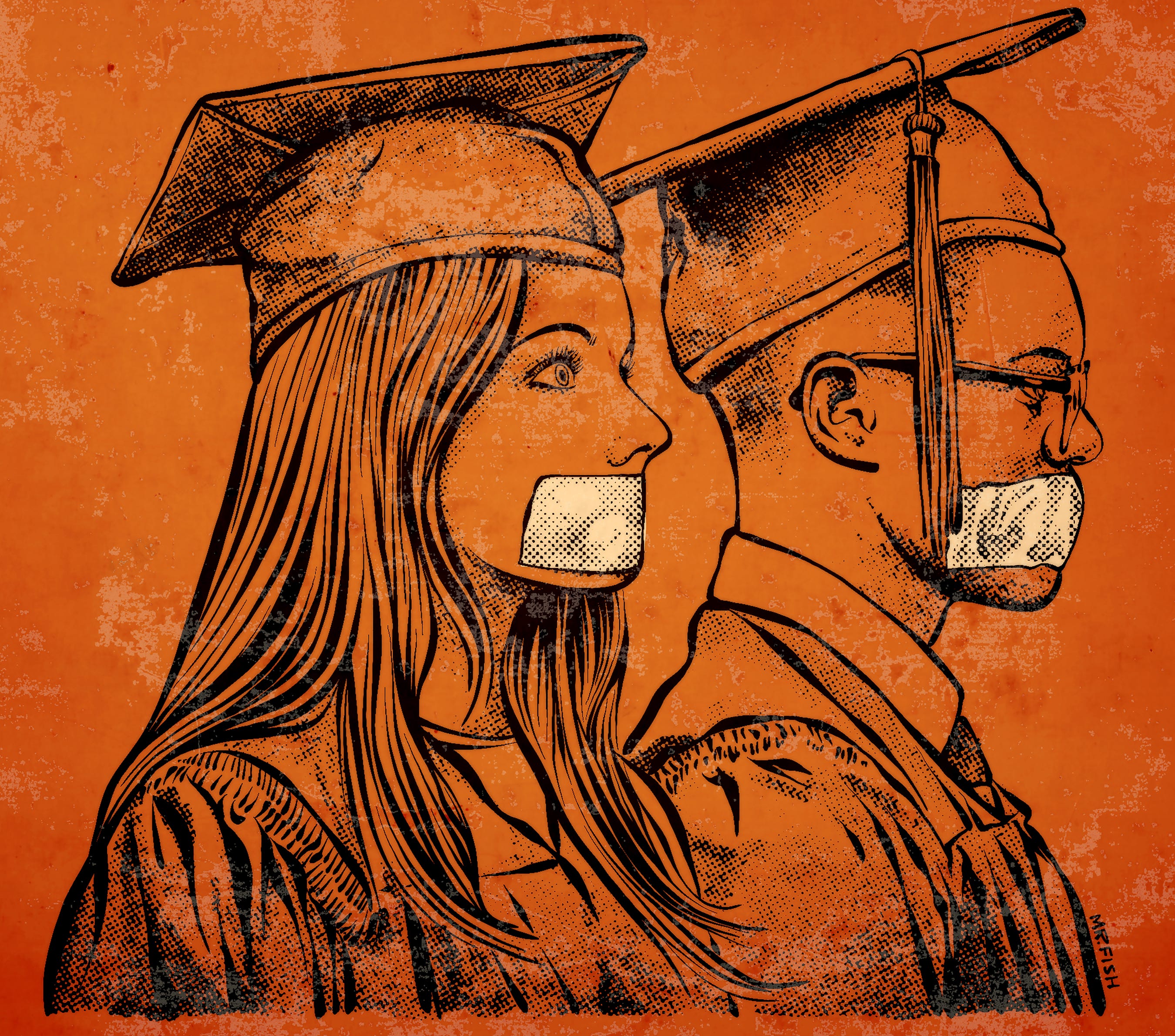
Shooting someone in the back of the head because you imagine they’re going to fill their lungs with the same precious air you breathe and then they’re going to run that misappropriated air over their wretched vocal cords for the purpose of expressing an opinion that you don’t share should never be justified by the wholly discredited theory of social Darwinism, although powerful people do it all the time, sometimes with actual bullets, sometimes with fountain pens, sometimes by sucking the oxygen out of every scenario wherein the weightlessness of words requires the guarantee of equalized air upon which to free associate.
Then again, sometimes all that is required for the enslavement of speech that yearns to be free is the deliberate falsification of the physics through which ideas are typically funneled. Verily, when words are threatened with abduction by those heralding disfigurement of the speaker’s intent, self-censorship seems the only viable option, hiding being the best survival technique for those cowed by the confusion guaranteed by a threat whose invisibility gives the impression that it is everywhere all at once when, in fact, it is nowhere at all. Thus, we are left living in a world where most people are more likely to refrain from publicly telling a pedophile with blue eyes that he should stop raping children because there is the possibility that such an excoriation could be misconstrued as a sweeping condemnation of blue eyes.
And while it would not be hyperbolic to suggest that both of these scenarios are serviceable metaphors for how leadership and those compelled to exist in devotion to the absolute authority of leadership manifest in the real world, it is important not to pretend that such pitiless lunacy is relegated to only fools and dunderheads. It is not—not when the whole of civil society has been deliberately structured on the commodified exploitation of our differences and the miserly accruing of wealth and power as opposed to sharing it. Remember, wealth and power only have agency when hoarded and dissipate when dispensed evenly, the idea being that while a single person with one-hundred dollars might feel empowered to manipulate ninety-nine others with no money, one-hundred people in possession of a single dollar each have the greatest potential to see each other as equals and are therefore closest to making the strongest argument against the need for capital’s fractious biases at all. So, believing we are contributing to the preservation of the commonwealth, we will continue to consider our ability to ignore the agony of those beneath the boot of the soft, medium, and hard despotism that sustains the integrity of our financial institutions as a remunerative virtue worth preserving. After all, because there has never been a way to commodify the most charitable acts of pure altruism, the sort that seeks neither recognition nor compensation, there has been little opportunity for the mass proliferation of agape, meaning there has been a moratorium on the sort of unconditional, selfless, and sacrificial love that would immediately negate the entire objective of our top-down political system; a system known since time immemorial to warrant the most horrendous behavior conceivable.
And whereas there are likely many more deterrents concocted nowadays—other than the purely economic—to disavow the average person of any responsibility to consider the lives of others as being as precious and as deserving of respect as their own, there is every reason to believe that the enforcement of such compulsory indifference once allowed to expand to a level of critical mass will eventually implode having set off a chain reaction of real despair so contagious and so threatening to the survival of the soul that universal compassion may be the only antidote remaining for us all to consider. In the meantime, however, we’ll likely continue, not as fools or dunderheads but as respectable members of the workforce, to make incremental decisions that prioritize the dehumanization of those we imagine to be in competition with for the praise and protection of the filthy rich—which, of course, is everybody!—while at the same time exercising every measure of petty contempt for those either unable or unwilling to sacrifice their basic decency in service of keeping the royal court of capitalism flush with the spoils of dominion’s most barbaric conquests.
As such, the problem with all the cascading failures prompted by a bureaucracy’s refusal to acknowledge the needs and dignity of the single human being because its loyalties reside squarely with the deep pockets who finance its impassivity is the profound frustration that comes from watching a pointless brutality that never should have happened in the first place as it is normalized by balance sheets and financial projections, then adopted as a sensible business practice, then automated for efficiency, then celebrated as an impressive feat of engineering, its operation as free from guilt as a windowless slaughterhouse that is able to reclassify the cattle, sheep, and swine that come panicked and shackled through the front door as anonymous livestock and who leave out the back as faceless slabs of non-shrieking accessories to the gruesome crime of advocating for profit over personhood. Of course, being coerced to pay fealty to the owners and operators of a slaughterhouse out of fear that you yourself could end up on a conveyor belt at butcher’s row for questioning the morality of the whole affair might make those who facilitate the ruination of other people’s lives in order to save their own appear less evil than those who actually mandate the killing, but what of those remitted as refuse to the body count? Doubtful that the permanence of death is affected one way or another by the reluctant mood of the finger that pulled the trigger or the amount of cold sweat in the palm on the hand that swung the blade.
Still, one can never escape the niggling feeling—nor should one ever try, even at the behest of bosses, deans, or presidents!—that when underlings are made to suffer amid the relative calm of privileged people who remain untouched by catastrophe that the resulting violence affecting those rendered defenseless by their subordination to power, though it often presents as incidental mayhem resulting from the ineptitude of those being victimized, is always being inflicted by choice rather than spontaneously combusting by chance. It has to, given the narrowly defined demographic of those felled by the resulting hardship, carnage, or abolition, meaning that every one of the choices made by those allocated to choose the fate of those denied that freedom is always made with total awareness of the innumerable offramps ever-present in all decision making, free will being nothing but the perpetual act of plucking prerogatives, mostly in service of self-preservation, from a surplus of possibilities.
So, when an entire population is dehumanized and marked for mass extermination such as in the case of the Holocaust, the East Timor genocide, the Cambodian genocide, the Isaaq genocide, the Bosnian genocide, the Rwandan genocide, the Darfur genocide, the Yazidi genocide, the Rohingya genocide, the Gaza genocide—just to name ten out of the estimated 180 recognized and recorded since 1945—one must assume that the hell on earth that suddenly revealed itself in each one of those instances as an inferno raging with enough apocalyptic animus to warm the faces of all those left alive to witness it, likely started with the lighting of an incalculable number of little matches, each strike an individual choice to ignite a tiny flame in anticipation of lighting another. Thus, a series of questions naturally arises: Who invented these matches and for what purpose, as if the intended use of any invention was what ultimately determined its function? Who is manufacturing these matches and who is selling them? Who is buying them—no, a better question would be who can afford to buy them and who cannot? Does our collective fascination with fire negate all safety concerns that might legitimately argue against the potential misuse of matches? Are we too often distracted by the pyrotechnics demonstrated by fire, namely its carnivorous impulse to migrate and feast upon whatever it can for the purpose of surviving and evolving into something magnificent, to even notice what is being revealed by the light it casts? By even asking these questions are we stupidly assuming there exists a version of reality where the matches are somehow so alluring and seductive that they’re in control of us, so much of who we are being what our desires pursue in contemplation of filling in the parts of ourselves that wouldn’t exist without symbiosis with the outside world? Because these matches are merely symbols, what do they actually symbolize and why do we so often allow symbolism to supersede the significance of actual reality as if allegory had more to tell us about how the world works than the world itself? When we create a lie to reveal a truth, how are we expected to convert our explanation of that truth into something that is immune to misinterpretation and the generation of more and more editable lies able to exist further and further away from the objective truths they were designed to encapsulate?
Of course, attempting to boil down human misbehavior into a simple equation using a series of labored metaphors about matches would ultimately be too reductive to reflect the complexities of all that goes into the creation of a single circumstance, not to mention all the possible reactions one might have to those complexities. Indeed, while the predictability of how one is likely to conduct oneself when confronted with a loyalty test where betrayal is punishable by pain and fealty is rewarded with an exemption from pain is largely calculable, it is never 100% guaranteed, meaning there is always going to be a chance for something unexpected to happen, one of those things being the exercising of independent thought followed by the potential for free and fearless speech offered in support of subverting the stranglehold that power will forever claim to have over the powerless.
When, for example, I was asked by the U.S. House Committee on Education and the Workforce at the beginning of what would turn out to be my last semester of teaching at the Annenberg School for Communication to produce my “C.V./Resumes, all syllabi since the fall 2022 semester, all course-wide communications for courses since the fall 2023 semester, and any communications since 8/1/23 relating to the Gaza Solidarity Encampment, Faculty for Justice in Palestine, and/or the Palestine Writes Festival,” I could have easily bowed to the enormous pressure I was feeling, much of it coming from the University of Pennsylvania, itself, to cooperate with a federal government that had spent the previous year openly destroying the lives of college professors and students who had refused to capitulate to its authoritarian demands regarding the right—no, the responsibility—to boldly oppose the genocide in Gaza. Mind you, this brass-knuckled request came to me at the end of a very long year where I had pretty much waged a one-man battle against the snarling hate groups and rightwing nationalists that had started accusing me of antisemitism after discovering my artwork critical of Israel. My response, of course, to the request from Congress was this:
Respect for the privacy of my students and colleagues and the norms of the classroom compel me to decline to share communications. Nor am I able to cooperate with any request for privileged correspondence I’ve had with friends, family, or professional personnel with whom I associate as a scholar, cartoonist, artist, writer, activist, and journalist. Any such request is an unjustified attempt by Congress to abridge my rights to exercise free speech and free association.
By refusing to cooperate, I was then advised by the UPenn attorney who had delivered the message for the House Committee and who had been asked to relay the thinly veiled threat to lawyer up and brace for a legal nightmare I’d be unlikely to survive. This, of course, came to me as an empty blast of hot air, not from the front of an advancing hyena but rather from the rear of a retreating one.
Indeed, from the beginning of the doxxing campaign against me, the Annenberg administration, as timid and craven as a shareholder in a fracking company whispering its contrition into a very expensive pillow, suggested I remain silent, being much more afraid of how the donors and trustees of the university might react to my abhorrence of elite war criminals than of those threatening the lives of me and my family. All things considered, after being publicly slandered by the president of the university and witnessing Annenberg’s repeated refusal to issue its own public statement of support for the free speech rights of myself and others employed or enrolled at the school, the newest requirement for retaining one’s job, apparently, being a willingness to act as an informant for Hillel, AIPAC, the Canary Mission, Turning Point USA, and any elected official with a price tag dangling from his or her rented soul, there was honestly nothing else I should have expected but termination. In fact, given every telltale clue leading up to my firing—starting with the plea for my prostrating silence, followed by the request that I remove all cartoons and commentary condemning genocide from my professional website and social media platforms, followed by my being banned from attending graduation ceremonies, followed by the canceling of my courses all having to do with the history and importance of open debate, free expression, and how best to resist fascistic takeovers of democratic traditions and institutions with an emphasis on recognizing our reciprocal duty to speak out against the coercive pressures often extended by authoritarian superstructures needing to crush dissent and impose absolute control over the hearts and minds of its population—it was amazing that I lasted as long as I did, especially after watching over the course of eleven years the university’s motto go from Leges Sine Moribus Vanae (“Laws without morals are useless”) to Ignavi Diutius Quam Heroum Vivunt (Cowards live longer than heroes”).